

WHEELDRIVE – Global geopolitical tensions affecting fuel supply and fuel price volatility are beginning to impact Indonesia’s logistics industry, particularly businesses with high distribution demands.
Rising operational costs and uncertainty in fuel availability are pushing companies to accelerate the adoption of more efficient and sustainable transportation solutions.
Responding to these challenges, PT Primarajuli Sukses (PRS), a subsidiary of PT Ever Shine Tex Tbk, has started implementing electric vehicles (EVs) for its logistics and distribution operations in collaboration with KALISTA, a provider of integrated commercial EV ecosystem solutions in Indonesia.
The transition to electric logistics vehicles is part of Ever Shine Group’s broader strategy to improve energy efficiency and support Indonesia’s net zero emission target by 2060. The company is also strengthening its renewable energy infrastructure, with approximately 70% of its future energy needs expected to come from renewable sources.
This includes an operational 1.34 MWp solar power plant, a 1 MW gas-based power facility, and an additional Phase 2 solar power installation with a capacity of 2.1 MWp scheduled to begin operations in July 2026.
Through KALISTA’s fleet-as-a-service model under an operating lease scheme, PRS is able to adopt electric trucks without making large upfront investments in vehicle ownership. Under this arrangement, KALISTA manages vehicle ownership as well as operational responsibilities such as maintenance, after-sales services, IoT integration, and fleet management support.
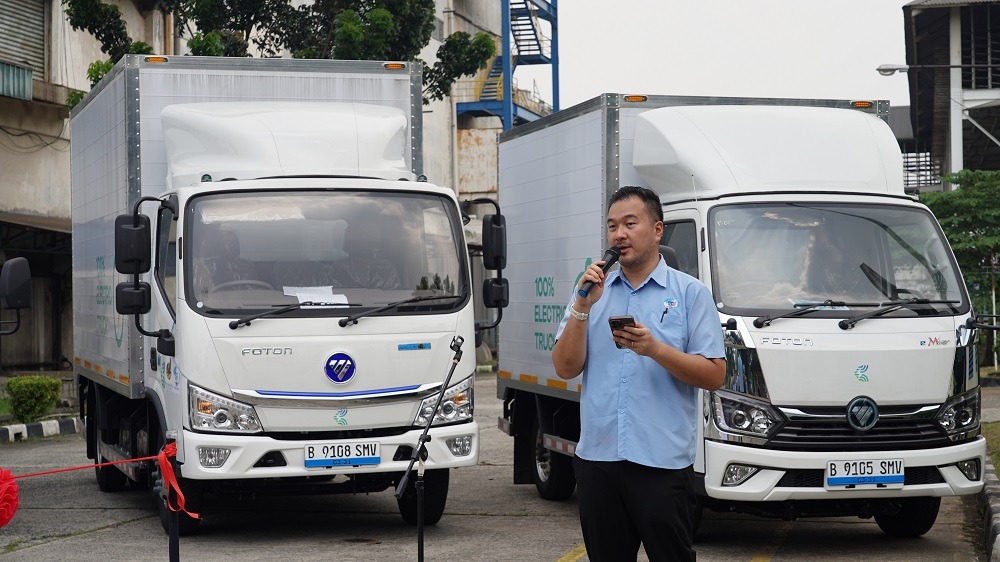
This approach enables PRS to focus on its core logistics and textile distribution operations while benefiting from the efficiency of EV technology. The initiative is considered one of the first EV logistics implementations in Indonesia’s textile industry and could become a reference point for other manufacturers seeking to transition toward sustainable transportation.
Michael Sung, Director of Ever Shine Group, stated that the company is proactively responding to fuel supply instability by adopting EV technology for operational transportation. He explained that six electric trucks are now being deployed for product distribution across Jakarta and Bandung, serving major customers including Uniqlo, Atalon, Shopee, Gojek, Grab, Torch, and Eiger.
According to him, operational trials conducted together with KALISTA delivered highly positive results, with fuel cost savings reaching up to 40%. In addition to electric trucks, the company has also introduced an electric minibus for employee shuttle services, which can also be optimized for logistics delivery when not in use.
To ensure optimal operational performance, KALISTA conducted a comprehensive analysis of PRS’s logistics routes and transportation patterns before selecting the EV units. As part of its integrated EV ecosystem services, KALISTA also designed the charging strategy, including charging infrastructure development and access to KALISTA’s public EV charging stations along the Jakarta–Bandung corridor.
Operational trials were conducted under real-world logistics conditions, allowing PRS to evaluate vehicle performance, charging efficiency, and operational reliability directly.
The entire EV fleet has also been integrated with KALISTA’s Fleet Management System (FMS), known as the K-Move Dashboard, enabling real-time fleet monitoring and operational visibility. This system helps improve route management, energy consumption tracking, and overall fleet efficiency.
Yoga Adiwinarto, Business Development Director at KALISTA, said the collaboration reflects KALISTA’s commitment to accelerating sustainable logistics solutions in Indonesia amid ongoing fuel supply uncertainty.
He noted that electric vehicles not only reduce emissions but also significantly improve operational efficiency. Based on operational testing, the company recorded overall logistics operational cost savings of up to 27% per month.
He also encouraged other logistics and manufacturing companies to begin transitioning toward EV-based transportation systems through integrated ecosystem support from planning to day-to-day operations.
The fleet deployed by PRS includes four Foton E-Miller electric trucks equipped with 81.14 kWh battery capacity and payload capability of up to 4 tons, along with two Foton E-Aumark electric trucks featuring 63.75 kWh battery capacity and payload capability of up to 2.5 tons. Trial results showed that both truck models can travel up to 200 kilometers on a single charge.
For the Tangerang–Bandung route, charging activities are carried out during driver rest periods, ensuring operational continuity without delivery disruptions. Charging from 20% to 80% battery capacity takes approximately 40 minutes.
Before beginning daily operations, all EV units are initially charged at the PRS charging station located at the company’s manufacturing facility in Tigaraksa.
Overall trial results demonstrated strong operational performance, including energy cost savings of up to 40% per month, emission reductions of around 30%, and total operational cost efficiency improvements of up to 27% monthly.
The adoption of electric trucks in textile logistics operations highlights the growing potential for EV implementation across Indonesia’s industrial and logistics sectors. As energy prices continue to fluctuate and sustainability standards become increasingly important, EV logistics solutions are expected to gain wider adoption among Indonesian businesses seeking long-term operational efficiency, lower carbon emissions, and greater energy resilience.