

WHEELDRIVE – Changan Automobile reported record-breaking performance in 2025, driven by strong new energy vehicle (NEV) sales, rising overseas demand, and accelerated global expansion.
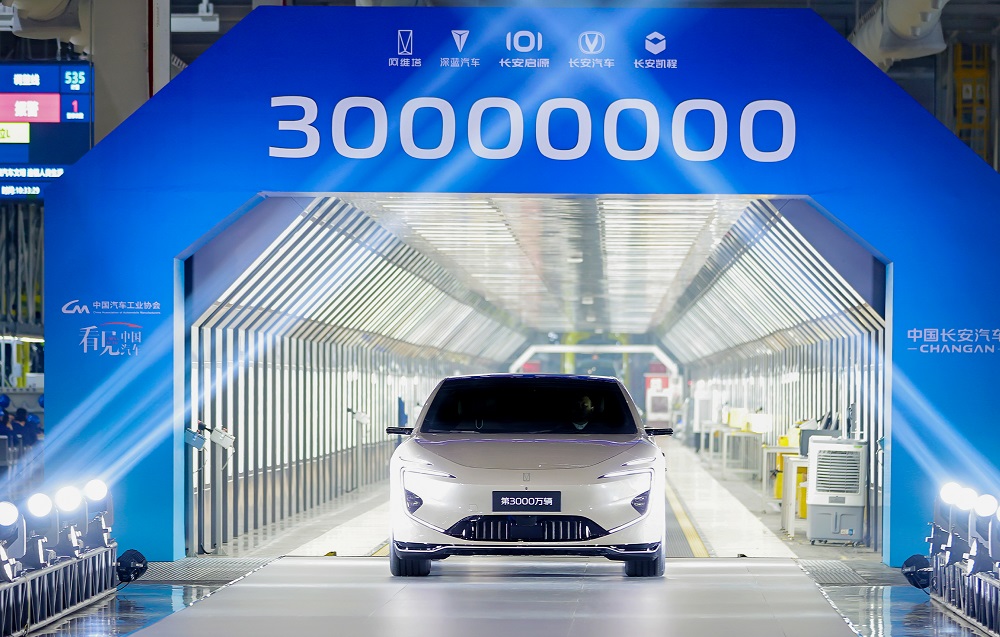
The company sold 2.913 million vehicles in 2025, marking an 8.54% year-on-year increase and the highest annual sales in nine years, while cumulative vehicle sales reached 30 million units, reinforcing Changan Automobile’s position as one of the fastest-growing Chinese automakers in the global automotive market.
Changan Automobile’s NEV sales surged to 1.11 million units in 2025, increasing 51.1% year-on-year and setting a new record, highlighting the company’s rapid growth in the electric vehicle segment and its competitiveness in the China EV market 2025.
Overseas sales also reached an all-time high of 637,300 units, up 18.85% year-on-year, reflecting strong global demand and continued success in Changan Automobile’s international expansion strategy across key markets.
In terms of financial performance, Changan Automobile generated RMB 164 billion in revenue in 2025, representing a 2.67% year-on-year increase. Net profit attributable to shareholders reached RMB 4.075 billion, while normalized net profit rose 8.03% year-on-year to RMB 2.795 billion.
The company continued to strengthen its long-term competitiveness through increased investment in innovation, with R&D spending reaching RMB 12.6 billion, accounting for more than 7.67% of total revenue and growing 24% year-on-year, positioning Changan Automobile among leading global automakers in research and development efficiency.

Changan Automobile’s multi-brand strategy continued to drive strong sales momentum across premium electric vehicles, passenger cars, and commercial vehicles. AVATR recorded annual sales of 123,472 units and maintained monthly sales above 10,000 units for 10 consecutive months, while also gaining recognition in the Global Unicorn 500 ranking.
CHANGAN DEEPAL delivered 325,096 vehicle sales, increasing 44.4% year-on-year and surpassing 400,000 cumulative units in just 29 months, setting a new benchmark in the competitive EV segment.
CHANGAN NEVO achieved 410,495 units sold, up 42.6% year-on-year, supported by strong demand for new models such as Q07, A06, and the All-New Q05, which generated 20,000 orders within its first month of launch.
The CHANGAN UNI series remained a major contributor to overall sales, reaching 919,721 units in 2025, while the EADO series ranked first in China’s gasoline sedan segment with 210,599 units sold and cumulative sales exceeding 2 million units as of April 2026. The CS75 series also delivered strong performance with 217,522 units sold, surpassing 3 million units in total cumulative sales.
In the commercial vehicle segment, CHANGAN KAICHENG recorded 260,648 units sold, up 17.8% year-on-year, with export sales rising 31.1% and pickup truck sales reaching 56,644 units, reflecting growing demand in international markets.
Changan Automobile continues to advance its long-term strategy focused on new energy, intelligent mobility, and global EV sales growth. Under its Green Plan, NEV sales exceeded 1.11 million units, while the BlueCore HEV platform signals the beginning of a new hybrid vehicle era.
Under the Intelligent Plan, Changan Automobile obtained China’s first official L3 autonomous driving test license in 2025 and, in March 2026, secured approval for L4 Robotaxi testing on public roads, reinforcing its leadership in autonomous driving technology.
The company also established a new robotics business focused on SDA Intelligence, further expanding its innovation capabilities in next-generation mobility.
Through its Vast Ocean Plan, Changan Automobile expanded into 21 new markets and now operates in 118 countries, supported by a global network of 1,100 outlets, strengthening its position in the global automotive industry.
At the same time, the company continues to enhance its ESG performance, with carbon emission intensity per unit of industrial output reduced by 28% compared to 2020 and lifecycle carbon emissions per vehicle down 18%.
Installed photovoltaic capacity reached 288 MW, with annual power generation of 281,500 MWh, reducing carbon emissions by more than 200,000 tons and supporting sustainable development goals.